Thirty years of the journal online and searchable, audio on every essay, editing screens the staff run on their own, and sign-ups that reach their mailing list.
Fill events and sign-ups. Print and newsletter sign-ups that reach the supporter database.
Take gifts or orders. A small Give panel between article paragraphs.
Take office work off staff. Sign-ups go straight into the database the office already uses.
Crew listThis project
StrategyNathan Nixon
DesignNathan Nixon
The buildNathan Nixon
#F6F1E7
#7A1F2B
#14253F
#1C1A17
Set in Newsreader, IBM Plex Sans
The brief
A Reformed quarterly rebuilt as a real publication, with every issue since 1995 online and read aloud, editing screens the staff run themselves, and sign-ups that feed their supporter list.
Theology Matters is a Reformed and Presbyterian journal edited by Dr. Richard E. Burnett. It has been mailed free, four times a year, to anyone who asks since the mid-1990s, and it also runs an annual theology conference and an institute for theological education. The content is serious: several authors an issue, three decades of back issues, conference lectures, and a course of study for working ministers.
The old site sat on a dated theme. Changing it meant editing code, so adding an issue, a speaker or a faculty listing waited on a developer, and most of the back catalog lived only inside the issue PDFs. The rebuild had to make the whole journal readable and findable, let a small staff run it themselves, and turn readers who want the journal into names on the mailing list.
The new site went live in spring 2026, and I have kept building on it since: a full redesign of every page, the back issues brought online as real articles, rebuilt editing screens for the staff, and new sign-up forms.
94
people asked for the print journal through the site in the four weeks after the new request form went live
Source: Google Analytics for theologymatters.com, 16 October to 13 November 2026, shared with the journal’s permission
458
essays to read online, from every issue of the journal since 1995
Source: a count of the journal archive on theologymatters.com, October 31, 2026
About 65%
of those essays (about 300) existed only inside old PDF issues. Now each is a proper page with its own author and issue
Source: my record of the import
The staff publish an issue, add a writer, and update the Institute and Conference pages themselves, with a guide and a video for each job.
Print, newsletter and stop-or-move requests go straight into the supporter database the office already emails from, with a confirmation for the reader.
Every essay in the archive has an audio version, the back issues included.
Every issue since 1995, online, searchable and read aloud
theologymatters.com
Searching the Theology Matters archive for "Barmen": the results list the articles and issues since 1995 that mention it
Decisions
Every essay read aloud, automatically
The easy version
Record and upload an audio version piece by piece.
What I did
Give every essay, back issues included, a Listen to this essay button with a natural-sounding computer voice, made automatically. The editors never record anything.
Editing screens built around the jobs
The easy version
Hand over the standard WordPress editing screens and a written manual.
What I did
Stay on WordPress, which the staff already knew, and reshape its editing screens around what they actually do: prepare an issue, add a writer, change the conference program. Guided forms, a checklist before anything publishes, undo on every edit, and a Site Guide with short videos for each job.
Sign-ups that land where the office works
The easy version
Leave sign-ups in a separate inbox for someone to copy across by hand.
What I did
Build the newsletter, print edition and stop-or-move forms into the site, check each one for spam, and send it straight into the supporter list the office already sends its email from.
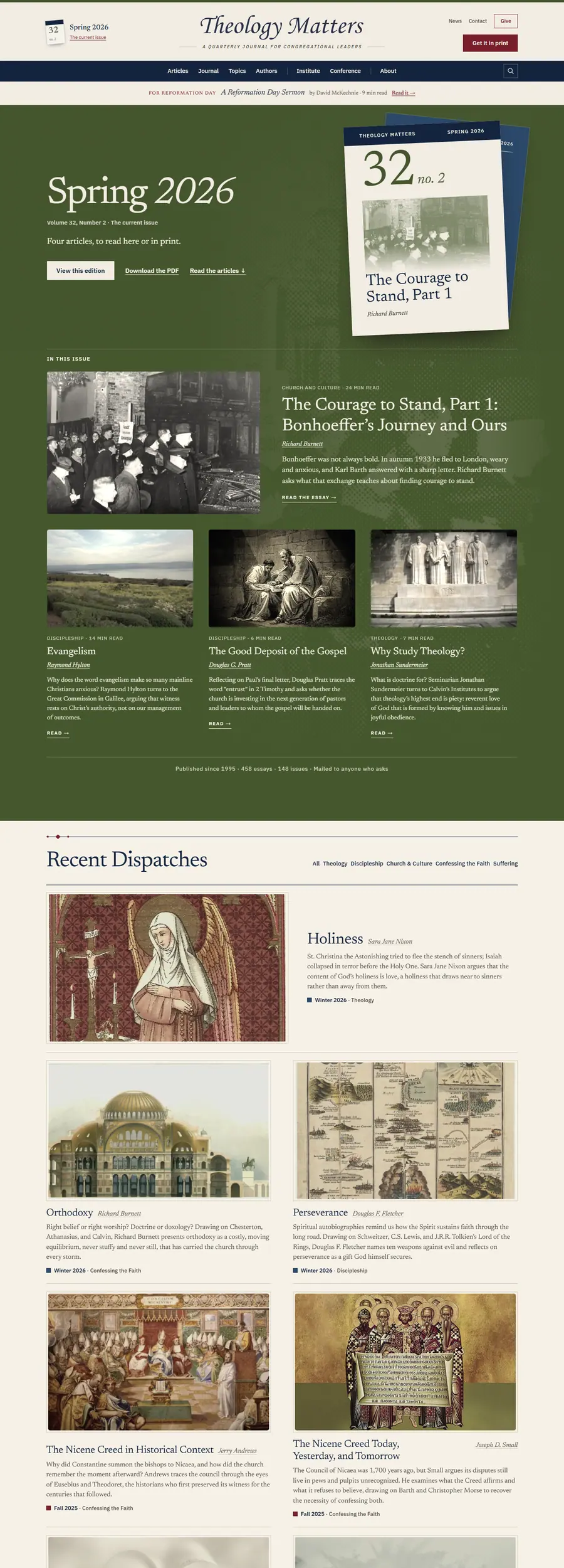
Walk the homepage
The real homepage, top to bottom. It scrolls along as you scroll this page.
Where the staff make changes, on the first screen after signing in. The WordPress home screen I built for Theology Matters, with tasks like adding an article and a list of scheduled articles.
theologymatters.com/wp-admin
In their words
Written in 2025 about my earlier work on the site. They came back for this rebuild in 2026.
Nathan Nixon transformed our website from a slow, clunky station wagon to a fast, beautiful sports car. Without compromising the integrity of our message, he's made it more attractive. Exceedingly competent and easy to work with, he has helped enormously to advance our mission.
Left on Google after the 2026 rebuild of both sites.
Nixon Creative Studio has completely transformed our media presence. We now have half the hassles and ten times the hits.
Richard BurnettManaging Editor, Theology Matters, and Executive Director of the Foundation for Reformed Theology
With Theology Matters, Nathan went even further. He rebuilt and modernized our website, then seamlessly connected our CRM platform to it. That has been a huge success and a real time-saver. We now respond faster to our readers and serve our donors better than ever before. … He has a sharp eye for function and an intuitive sense of how people actually move through a webpage.
Clark RemsburgAssociate Director, Theology MattersShortened from his 2026 Google review, which covers this site and First Presbyterian Church of Orangeburg. The link opens all of it.
1 / 3
Every issue since 1995, on one shelf The journal archive shows each year's issues as covers with their articles underneath. Three hundred back-issue articles that only ever existed inside the issue PDFs are now full pages with their own authors, issue and date, so the whole run of the journal can be read and searched.
2 / 3
Read it, hear it, cite it Every essay has an audio version, a Cite button, text size controls, a contents list that follows along, and footnotes that open in place. A reader can listen in the car and cite the same piece in a paper.
3 / 3
Asking for the journal takes one form The print sign-up asks for an address and a few questions about the reader's ministry, then sends a confirmation email before anything is mailed. A short form handles moves, extra copies and stopping, and a newsletter sign-up sits on the home page and between article paragraphs.
The rest of the build
For readers
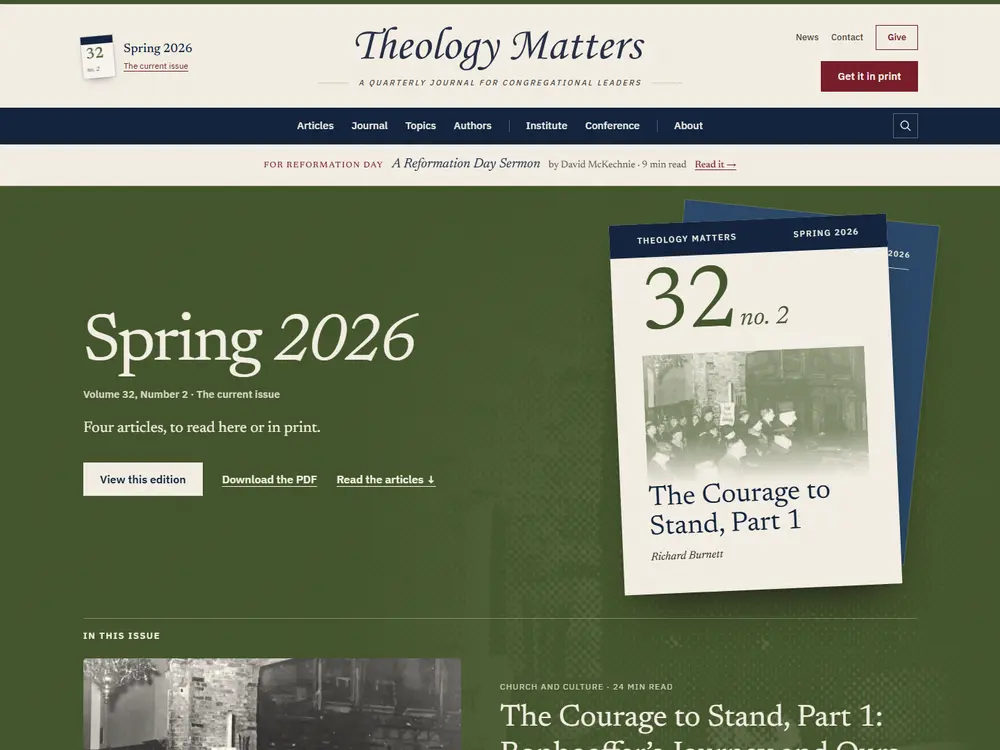
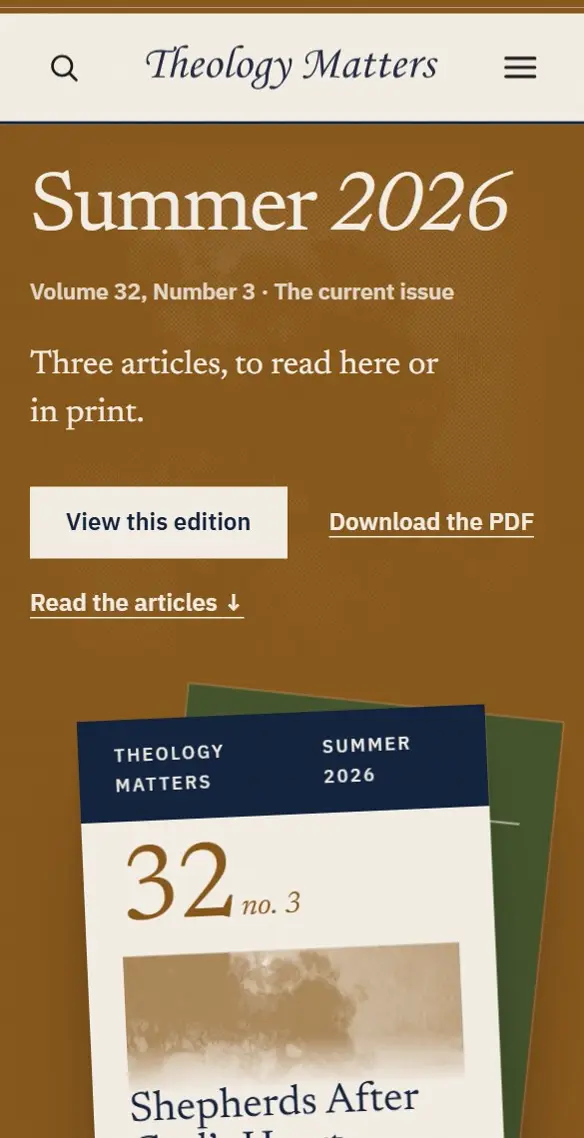
A redesign of every page: a nameplate header with the current issue, season-colored issue covers, typeset articles with drop caps and small caps, and section photographs
Search across every article, author and issue, including the full text of the issue PDFs, with phrase search, Scripture references (“Rom 8” finds Romans 8), suggestions as you type and “Did you mean”
Topics and authors indexes with an A to Z strip, and author pages across each writer’s work
Small Give, Newsletter and Institute panels between article paragraphs, so the ask sits where readers already are
An Institute page and a Conference page with lectures, speakers and workshops
Every article labelled for search engines as a scholarly article, so Google Scholar can list the essays as journal articles
For the staff
A home screen for the staff: task buttons, what needs a look, what is scheduled, and recent changes with an Undo link
Prepare an issue: pick the season, the PDF, the articles and a release time, and the site publishes the whole issue at that moment
Start an article from a Word file, footnotes included, and add a new writer from the article screen
A Before you publish checklist beside every article, which also warns when another article already uses the same picture
A daily summary of changes, and no way to delete anything permanently by accident
The Institute and Conference pages edited by filling in plain boxes, not by dragging page parts around
Private preview links for drafts, and a Share this article box with ready-made posts for social media and the newsletter
Form messages screened for spam and passed to the supporter list, with anything unclear set aside for a person
Behind the decisions
The look comes from academic press publishing: cream paper, oxblood and navy, and a book typeface for reading. Each issue gets a cover in its season’s color, so a run of issues reads like a shelf. Scripture references show the verse when you point at them.
Time cardTheology Matters
The build, week by week
5 of 5 weeks had changes, from the week of
October 12, 2026.
One square for each week of the site's change history, filled where something changed. As of November 9, 2026.
For the technically curious, it is built with WordPress, Bricks Builder, ACF, ElevenLabs, Neon CRM, Cloudflare.