School3 min read
The Presbyterian Academy
The Presbyterian Academy
A launch site for a brand-new Reformed lay formation school that needed to explain what it is, who it's for, and how to enroll, all before the first cohort began.
Outcome
A credible front door for a brand-new school: clear catalog, real faculty, honest pricing.
Role: Designer, Developer
Built with: Astro, Sanity, Tailwind, Cloudflare Workers
- Strategy
- Web Design
Tags: Education, Course Catalog, Enrollment, Launch

The brief
The Presbyterian Academy is a Reformed lay formation school launched in 2026 by the Presbytery of Cincinnati. The mission is adult theological education in cohort form: semester-length in-person courses for people who want to study Reformed theology seriously but are not pursuing ordination. There is nothing quite like it in the region.
They came to us with the name, the faculty, and a start date. The site needed to do three things before the first enrollment cycle closed: explain what the Academy is, establish that it is serious, and convert interested visitors into enrolled students or at minimum a scheduled intro call.
The approach
Brand-new organizations have a trust problem that established ones do not. There is no press coverage to cite, no multi-year alumni network to quote, and no decades of institutional history to point to. The site had to build credibility from what actually existed: a compelling faculty roster, specific course descriptions, and pricing that did not hedge.
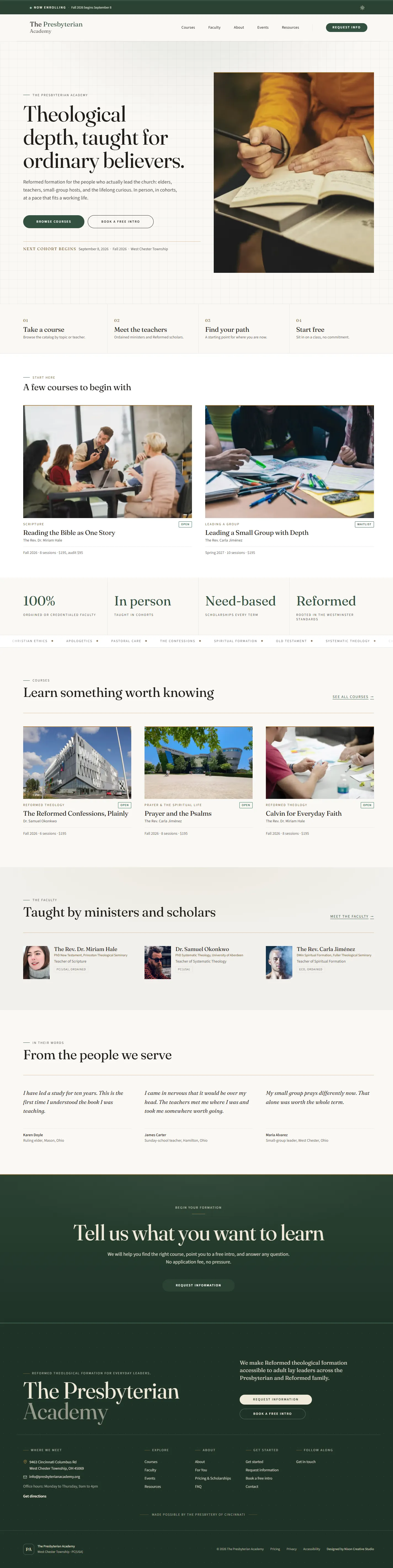
We organized the architecture around three conversion questions in sequence. What is this? Is it for me? How do I start? Every page answers at least one of those. The homepage handles the first. The course catalog and faculty directory handle the second. The enrollment and contact pages handle the third.
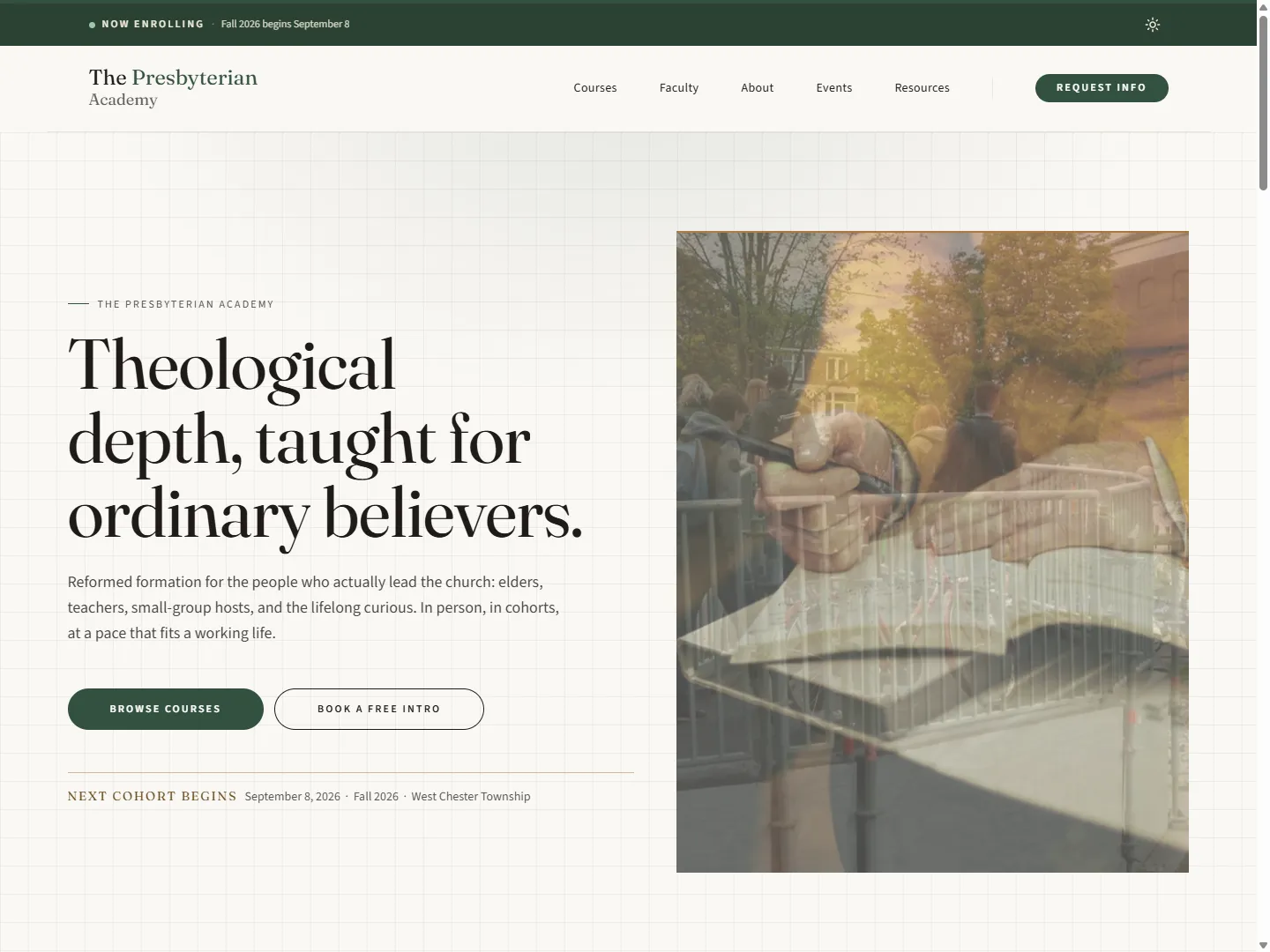
For the visual language, we landed on what we called bookish minimalism: warm near-white paper tones, near-black ink, deep forest green anchoring the palette, and brass hairlines as structural dividers. Display type in Fraunces paired with Source Sans 3 for body. No hero photography of empty lecture halls; the design is text-forward because the product is text-forward.
The CMS runs on Sanity so the Academy team can update courses, faculty, terms, and enrollment status from a dashboard without involving a developer.
What we built
A catalog that answers 'is it for me?'
Every course shows its topic, teacher, term, and price at a glance, with an open or waitlist status, so a visitor can size up the fit without emailing to ask.
Credibility from the people teaching
A full profile for every teacher, each an ordained minister or credentialed scholar, does the trust-building a brand-new school cannot lean on history for.
The full build, including the pieces above:
- Course catalog with individual course pages, including a sticky enrollment-action aside on desktop so the sign-up path stays visible while visitors read the course description
- Faculty directory with full biographical profiles, written to establish the weight of the teaching roster
- Term listings showing enrollment periods with open/closed status and upcoming dates
- Pricing tiers and need-based scholarship information, presented without “contact us for pricing” hedging, because the audience making a semester-long commitment deserves straight numbers
- Testimonials section seeded from early cohort participants
- Express interest form connected to Web3Forms for visitors who are ready to raise their hand
- Calendly integration for intro call scheduling alongside the form
- Homepage with a six-image Ken Burns slideshow hero that sets an academic, bookish tone without requiring event photography
- Enrollment status live in the site header so every page shows whether the current term is open or closed
- Full Sanity CMS for courses, faculty, terms, testimonials, and configuration
What changed
- A brand-new school now has a credible front door, with a clear catalog, real faculty, and honest pricing, ready for its first enrollment cycle.
- An interested visitor can size up the fit, then take a clear next step through the express-interest form or an intro call.
- Full faculty profiles and a course catalog now do the credibility work a brand-new institution cannot lean on history for.
- The Academy team can update courses, faculty, terms, and enrollment status from a dashboard without involving a developer.
- Pricing tiers and the scholarship process are published up front, with no "contact us for pricing" hedging.